Monday, September 27, 2010

The Marans & Ameraucanas - Grown up!

It's been a long time since I've updated on these guys too. They are what create the colored eggs on the above photo. Also, this will be a good time for me to show the difference between Ameraucanas and Araucanas. (but remember, hatcheries and feedstores do NOT sell either of them, no matter what they say!)

Here's my Ameraucanas so far. . . My Blues, Blacks, Wheatens, and Blue Wheatens.

This is my main blue cockerel, Poseidon.


This is my main black cockerel, Hades.


This is my currently broody blue pullet.


And here's another blue pullet, but she's so dark of a blue she's nearly black.


This is my black pullet, enjoying the vast reaches of our pasture.


Also, here's our current Blue Wheaten pullet who's laying. . . Her tail was taken by a goat.


Here's a Wheaten pullet.


And here's a gorgeous example of a Blue Wheaten Ameraucana egg! (it is small because it was her first)


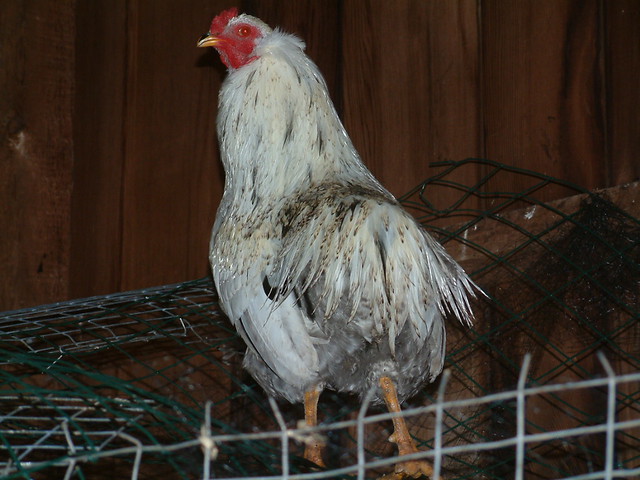
Last but not least, this is "Sultan," an odd "White Wheaten" cockerel as I like to call it - He's white, but hatched from a wheaten/blue wheaten batch of eggs.


Now onto the Marans. . .

Almost all of my Marans are now laying, and at the moment I'm typing this, I'm collecting every single egg and putting it up for sale. So, to take a quick tour through the colors of Marans I have. . . We'll start with the Blue Wheatens and Wheatens.

Here's my Blue Wheaten cockerel. He's lanky and really needs to fill out, but otherwise quite nice.


Here's my Wheaten cockerel. He's quite an eye-catcher, and always takes good photos.


And now, the girls. . . I used to have the most gorgeous Blue Wheaten pullet around, but she went broody far out in our pasture and one night got dragged off by a raccoon. So, I've got Wheatens left. Most are okay, one in particular is stunning!


And last but certainly not least - My Black Coppers. These are the "big prize" Marans who lay the darkest of eggs. I have three different breedings of them, and am in the works of improving both egg color and body conformation and color. Some of my girls hardly even have copper on them, while one of my boys has a side-spring on his comb.

Here's the boys. . .

This is Guitard (pronounced goy-urd)


This is Cacao (His tail was eaten by a goat)


This is a cockerel currently nicknamed "Five Pointer."


These two are the bothers, "Five Pointer" and Guitard.


Two Black Coppers and my Blue Wheaten


And here's a small sample of the girls. Note the lack of copper.


Friday, September 17, 2010

The Araucanas - Grown up!

So, it has been quite a while since I've shown you how my Araucanas have turned out. First you saw the chicks, then you saw the scruffy'uns, then a sampler of last month. . . Here's my Araucanas now.

First, a little round of the boys. I have culled down dramatically from 31 Araucanas to 16, with the population drop being in boys. I'm only keeping one of each color, and of each color I prefer to work with. For example - I had a lot of blue and black boys, but I'm not working with blue or black, because they all had too much duckwing/yellow leaking in their feathers. If I were to work with those colors, they'd be pure. So, I have these guys left:

Here's Marango. He's a Lemon Blue, which is basically a cross of duckwing and blue to the point of changing the patterning around to get this. It is gorgeous, and the female version of it looks simply like a blue hen, but with a silvery white necklace.


Here's my Blue Cuckoo cockerel who only goes by the temporary nickname of "Cookies and Cream." He's a barred blue Araucana who needs some cleaning up. As you can see, he's not exactly barred, due to having ducking alleles still in him, which dilutes the barring. So, I'll be working on cleaning that up so his offspring are completely barred.


This is Canis. He's a Splash cockerel, and has the absolute best pair of tufts out of all the 31 Araucanas we received. He really is a looker, too!


Now, we go onto the girls. The pullets. These girls vary also in color, but there's at least one of each that matches a color to my pick of the boys.

This is Josephine, actually, the only one who doesn't have a cockerel with a matching color. She's a Black Copper Araucana, a project color, wich if she were actually a Marans, would have what is called "mossiness." Otherwise, she's got gorgeous tufts and markings as well as a wonderful body!


This is Freyja. She's the female version of Canis. She's a splash, but without tufts (which is a good thing) and also the absolute smallest of our Araucanas!


Size comparison next to a Wyandotte.


Next up is an example of a Lemon Blue female - As stated, they're a typical blue but with a duckwing-type "necklace."


Another example, although this girl won't be bred as a Lemon Blue. I'm going for a goal with this color, and she's got too much brown and duckwing/BBR showing through.


Here's the female version of my Blue Cuckoo / Barred Araucana. This girl actually seems to be properly colored, but also has a leaking unwanted gene. I will still breed her though to get a normal Barred bird, not blue barred, so I can really see what I'm working with here.


And, last but certainly not least! The eggs! This, pictured below, is a collection of the first 3 eggs laid of each color of Araucana. They're organized in up-down columns.


From left to right: Lemon Blue 1, Black, Blue Cuckoo, Black Copper, Lemon Blue 2, Silver Duckwing.

As you can see, the eggs on the far left are quite green, almost an odd golden brown color. The hen that laid those will not be bred, except for crossbreeding. The 3rd, 4th, and 5th column will be bred.

Thursday, September 16, 2010

Picture Story 2: Tolbunt BOYS

Well, it has been 4 months now, and yes, you heard it. . . My frizzled Tolbunt Polish "pullet" is now a cockerel. For 4 months I've thought him to be a girl, named him Pink (after the artist) then suddenly found that my actually tricky-to-sex frizzle is a boy. So, he's now Spike (after the vamphire.) As for the other cockerel, he's still named Bowie.

Here's the two lounging side by side while it pours rain just beyond their covered porch.


Here's Bowie, the handsome "smooth feathered" cockerel. Just look at that patterning!!


And here's Spike, my crazy feathered but still beautiful "frizzled" cockerel.


And if you're wondering - Yes, I'm keeping them BOTH. They're in a separate run from everyone else, all to their own pampered selves, with my Silver Laced Polish hen, Oscura. I will still be working on this color, even if I don't have a female Tolbunt. I'm also on the look for a gold laced Polish hen. One girl and two boys is just too much for the girl to handle. Also, Silver Laced is NOT the best thing to use in improving Tolbunts.

So far, both are in excellent health. The frizzled is much more friendly than the smooth, and will come to call. They get along, although the frizzled is a little more dominant, despite his lack of physical maturity compared to the smooth, and noone has tried mating with the Silver Laced hen yet. Really cannot wait until I get some fertile eggs from them to hatch!!

Here's one last photo . . Or two. . . I can't get enough of them!!


Wednesday, September 15, 2010

Kinder Goats!

Finally got my camera fixed.

Well, here they come a . . . walking. Tried to get the whole herd of our new Kinder goats come a runnin' down the hill, as they usually do, but instead they take their dear sweet time walking. . .


The big one is Coral-Belle. She is our provider of cheese, yogurt, and milk.


. . . Any day now. . .


The black kid in lead is our little buckling, Aladdin.


Aaand snack break. From left to right is Aladdin, Angelica, Marguerite, Mallow, and Coral-belle.


Marguerite, following Angelica in the lead.


Despite the fact that they decided I'm not the point of their destination this time, Kinders are VERY sweet, loving goats.


And isn't Coral-belle just gorgeous? Those spots are amazing!! We're getting delicious cheeses, milk, and yogurt off her right now, and are also hoping she's pregnant, due for some babies come Christmas.

If there's one thing I'm certain of with goats right now, it is that I LOVE the Kinder breed! Far more than La Manchas. They're very freindly, laid-back, not the trouble makers most goats can be, produce an amazing amount of milk for their smaller size, and have an extraordinary 6-10% butterfat in their milk, which allows for MORE cheese!!